Key takeaways
- Dr. Virginia Apgar presented her five-sign newborn score in 1952; it was published in 1953.
- APGAR stands for Appearance, Pulse, Grimace, Activity and Respiration, each scored 0, 1 or 2.
- The score is checked at one and five minutes after birth, but resuscitation never waits for it.
- In 1949 she became the first woman appointed full professor at Columbia’s College of Physicians and Surgeons.
A baby is born. The first cry may bring relief, but for the medical team, the next few moments are about careful observation and quick decisions. Is the baby breathing well? Is the heart rate reassuring? Is there adequate muscle tone and a response to stimulation?
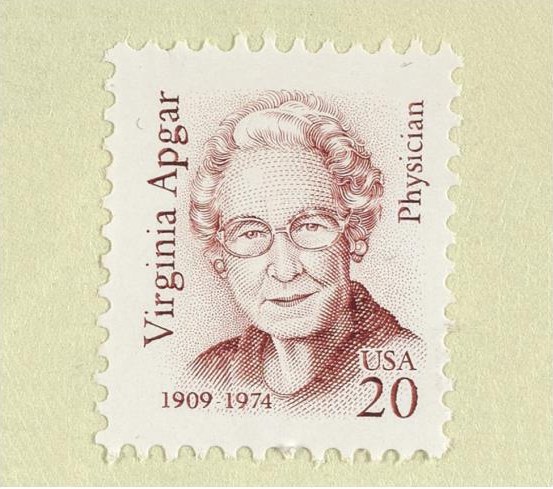
These questions underpin a familiar assessment used in maternity units worldwide: the Apgar score. Its creator, Dr. Virginia Apgar, revolutionized newborn care by turning these vital observations into a simple, standardized clinical tool.
A determined doctor with an unconventional path
Born on June 7, 1909, in New Jersey, USA, Virginia Apgar was a woman of many interests. She studied zoology at Mount Holyoke College before entering Columbia University’s College of Physicians and Surgeons, where she graduated in 1933, fourth in her class. At a time when women faced considerable barriers in medicine, she was determined to build a career in clinical practice.
Apgar initially wanted to become a surgeon. However, her mentor, Dr. Allen Whipple, advised her to consider anesthesiology, an emerging specialty with considerable scope for development. She trained in anesthesia and returned to Columbia in 1938 to lead its anesthesia division. In 1949, she became the first woman to be appointed a full professor at Columbia’s College of Physicians and Surgeons.
Her work helped establish anesthesiology as a recognized medical specialty. It also brought her into close contact with a question that would define her career: how could doctors assess a newborn’s condition quickly and reliably in the critical moments after birth?
An idea that changed newborn care
In the early 1950s, newborn assessment lacked a universally accepted scoring system. Clinicians relied largely on their own judgment to determine whether a baby was adapting well to life outside the womb. Apgar recognized the need for a method that was quick, practical, and consistent.
One popular account says she eventually sketched the idea on a napkin while in a hospital cafeteria.
In 1952, Apgar presented a scoring system based on five observable signs. Published in 1953, it offered clinicians a structured way to assess a newborn’s condition. Each sign received a score of 0, 1, or 2, giving a total between 0 and 10.
The system was named the Apgar score after its creator. A decade later, in 1963, the acronym APGAR was introduced as a mnemonic to help clinicians remember the five components:
- A – Appearance: skin color
- P – Pulse: heart rate
- G – Grimace: reflex response to stimulation
- A – Activity: muscle tone
- R – Respiration: breathing effort
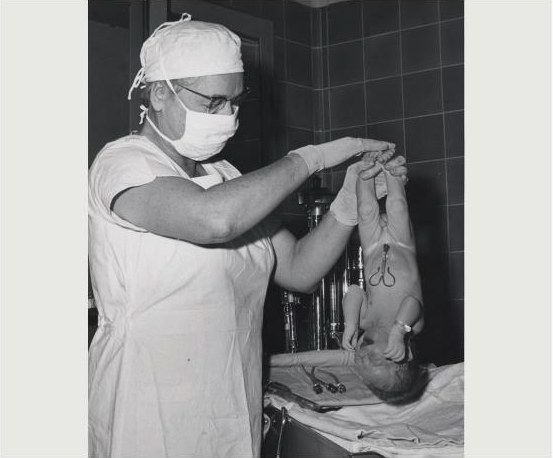
The score is routinely assessed at one and five minutes after birth. A low score alerts the clinical team to a newborn who may need additional support, while subsequent assessment helps evaluate the response to initial care. If resuscitation is required, however, it must begin without waiting for the score.
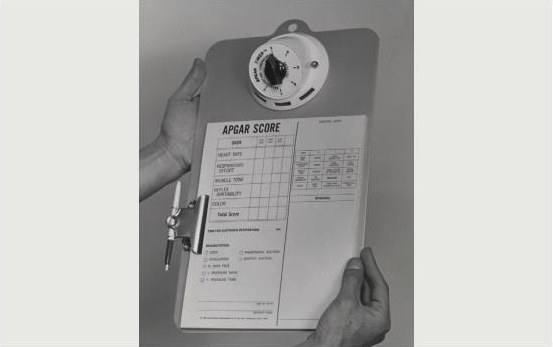
By making newborn assessment more systematic, Apgar gave healthcare professionals a shared clinical language. Her collaborative research, including a study involving 17,221 babies across 12 institutions, helped establish the score’s clinical value and advance understanding of newborn outcomes.
The score is not a stand-alone predictor of long-term development, nor is it intended to determine by itself whether resuscitation should begin. Its enduring value lies in rapid assessment, communication, and evaluation during a critical transition.
Beyond the delivery room
Apgar’s interests extended well beyond the first minutes of life. In 1959, she joined the US National Foundation for Infantile Paralysis (now the March of Dimes Foundation), where she became a prominent advocate for research and prevention of congenital abnormalities.
Following the rubella epidemic of 1964–1965 in the US, which caused devastating congenital abnormalities and fetal deaths, she helped raise awareness of the need for rubella immunization. She also championed Rh immune globulin to prevent hemolytic disease of the newborn in pregnancies affected by Rh incompatibility.
Apgar was equally committed to public education. She lectured widely, authored numerous scientific publications, and co-authored Is My Baby All Right? in 1972 to help families better understand congenital abnormalities.
She also enjoyed flying airplanes and played several musical instruments — interests that reflected her curiosity and zest for life.
She died on August 7, 1974, aged 65, but her influence continues through newborn care and public-health initiatives worldwide.
Nine months’ observation of the mother surely warrants one-minute observation of the baby.
A legacy measured in lives
Few medical innovations are as simple to remember, as easy to apply, and as enduring as the Apgar score. Its success rests on a powerful idea: five carefully chosen observations can help clinicians recognize a newborn in difficulty and communicate that need clearly.
Virginia Apgar’s achievement was not merely the creation of a scoring system. She drew attention to the newborn as a patient deserving systematic assessment, scientific study, and timely care. At a time when women had to overcome significant professional barriers, she also demonstrated how determination and practical thinking could reshape a medical specialty.
Today, her name is heard in delivery rooms across the world, often within minutes of a child’s arrival. Her legacy reminds us that medical progress does not always begin with complex technology. Sometimes, it begins with a keen observation, a simple question, and the determination to make those first minutes count.