Key takeaways
- Sleep alone can’t fix every kind of fatigue: rest can be physical, mental, emotional, sensory, social, creative or spiritual.
- Rest shifts the body into “rest and digest”, lowering stress hormones and supporting immunity and memory.
- Small habits help: pauses between tasks, quiet moments, peer support and time with people who energise you.
- Organisations share the work, with regular breaks, wellness programs and psychological safety.
“You do not have to be exhausted to deserve rest.”
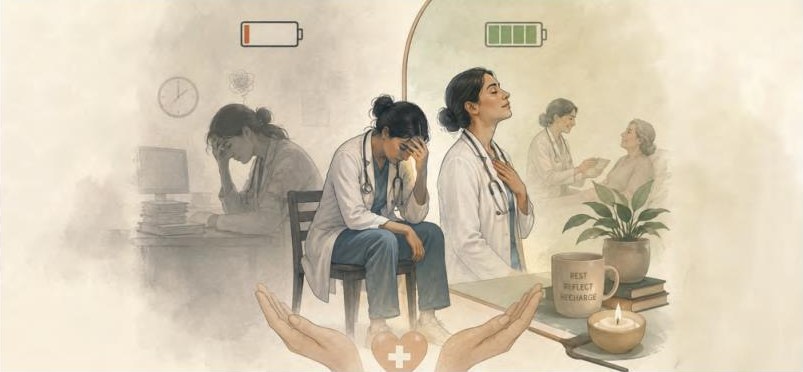
Healthcare is one of the most rewarding professions, but also one of the most demanding. Every day, healthcare professionals make critical decisions, manage complex clinical situations, comfort anxious families, and work tirelessly to improve patient outcomes. Yet even after a full night’s sleep, many continue to feel physically, mentally, or emotionally drained. The reason is simple: sleep alone cannot address every form of fatigue.
True well-being requires restoration across multiple dimensions of life. The concept of the seven types of rest offers a practical framework for understanding and combating the physical, emotional, and psychological fatigue commonly experienced in healthcare settings.
The physiology of rest
Rest is a complex neurophysiological state essential for maintaining homeostasis and optimal organ function. During rest, the body shifts from sympathetic nervous system dominance (“fight or flight” response) to parasympathetic nervous system predominance (“rest and digest” response). This transition reduces heart rate, blood pressure, myocardial oxygen demand, respiratory rate, and circulating catecholamines. Concurrently, anabolic processes become more active, facilitating tissue repair, protein synthesis, glycogen replenishment, and cellular regeneration.
At the neuroendocrine level, rest helps regulate the hypothalamic-pituitary-adrenal (HPA) axis, reducing secretion of stress hormones such as cortisol and adrenaline. During restorative sleep and periods of relaxation, growth hormone release increases, promoting tissue recovery and immune function. During these periods, the central nervous system consolidates memory, enhances learning, strengthens neural connections, and clears metabolic waste products through the glymphatic system, which plays a crucial role in maintaining brain health.
Rest significantly affects the immune system. Adequate rest improves natural killer cell activity, lymphocyte function, and anti-inflammatory pathways. At the same time, chronic sleep deprivation and prolonged stress are associated with immune dysregulation, increased susceptibility to infections, impaired wound healing, and heightened systemic inflammation. Furthermore, emotional and mental rest reduce sustained activation of limbic structures such as the amygdala, improving emotional regulation, cognitive flexibility, decision-making, and executive function.
For healthcare professionals who routinely face high cognitive workloads, emotional stressors, shift work, and long hours, rest is not merely a wellness intervention. It is a physiological necessity. Regular, multidimensional rest supports cardiovascular health, neurocognitive performance, immune competence, metabolic stability, and psychological resilience, enhancing both personal well-being and their capacity to provide safe and effective patient care.
Rest beyond sleep
Burnout, compassion fatigue, reduced engagement, and workplace stress are significant challenges in healthcare. Addressing them requires more than occasional days off or vacations. It requires intentional restoration.
Types of rest
The seven types of rest provide a useful framework for recognizing different forms of fatigue and identifying appropriate ways to recover. These dimensions often overlap, and individuals may need different forms of rest at different times.
The Seven Types of Rest offer a holistic approach to replenishing the energy we expend while caring for others.
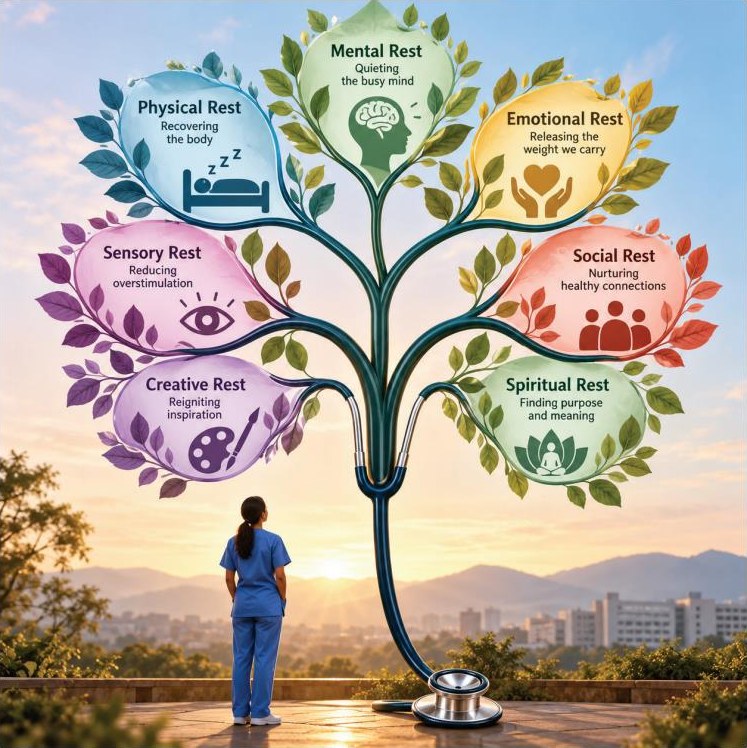
1. Physical rest: Recovering the body
Physical rest lets the body recover from the demands of daily work. In hospitals, long hours of standing, walking between wards, responding to emergencies, and performing procedures can place continuous stress on the body.
Physical rest includes:
- Quality sleep
- Short naps when appropriate
- Stretching exercises
- Walking and mobility activities
- Ergonomic work practices
When a person neglects physical rest, fatigue can accumulate, concentration may decline, and the risk of errors may increase.
2. Emotional rest: Releasing the weight we carry
Healthcare professionals routinely witness suffering, uncertainty, and loss. While providing emotional support to patients and families, they often suppress their own emotions. Emotional rest involves having safe opportunities to acknowledge and express feelings without fear of judgment.
Strategies include:
- Reflective journaling
- Peer support discussions
- Professional counseling when needed
- Setting healthy personal and professional boundaries
Making space for emotional rest helps prevent compassion fatigue and promotes resilience in challenging clinical environments.
3. Mental rest: Quieting the busy mind
Clinical decision-making requires constant mental engagement. Admissions, ward rounds, documentation, audits, quality improvement initiatives, and administrative responsibilities can create significant cognitive overload. Mental rest involves deliberately disengaging from cognitive demands.
Examples include:
- Taking brief pauses between complex tasks
- Practicing mindfulness
- Engaging in hobbies unrelated to work
- Disconnecting from work-related communication during personal time
Regular mental breaks help improve focus, creativity, and decision-making.
4. Sensory rest: Escaping constant stimulation
Hospitals are environments of continuous sensory input, including alarms, monitors, telephones, bright lighting, conversations, and electronic screens. Prolonged exposure to such stimulation can contribute to sensory fatigue and irritability.
Sensory rest can be achieved by:
- Limiting screen exposure after work
- Spending time in nature
- Reading a book
- Creating moments of quiet during the day
- Even a few minutes of reduced stimulation can help the brain reset and recharge.
5. Social rest: Choosing meaningful connections
Healthcare professionals spend much of their day interacting with patients, families, colleagues, and multidisciplinary teams. Not all social interactions are equally restorative. Social rest means surrounding ourselves with people who energize, support, and encourage us while also giving us space for solitude when needed.
It may involve:
- Spending time with family members
- Connecting with mentors and trusted colleagues
- Taking time for oneself without guilt
Healthy social relationships are powerful protectors against burnout.
6. Creative rest: Rekindling inspiration
Creativity is not limited to artists. Every healthcare professional uses creativity to solve problems, improve processes, teach learners, or develop innovative patient care solutions. Creative rest means stepping away from work’s constant demands and allowing oneself to experience beauty, inspiration, curiosity, and new perspectives.
Examples include:
- Writing
- Drawing or photography
- Learning a new skill
- Appreciating art, music, or nature
Creative rest renews curiosity and encourages fresh perspectives.
7. Spiritual rest: Reconnecting with purpose
Healthcare is more than a profession. For many, it is a calling. Yet amid busy schedules and operational pressures, it is easy to lose sight of the deeper purpose behind our work. Spiritual rest involves reconnecting with values, meaning, and purpose.
This may include:
- Meditation or prayer
- Reflection on meaningful patient encounters
- Community service
- Personal gratitude practices
Reconnecting with purpose can help healthcare professionals rediscover the meaning and fulfilment that drew them to the profession.
As healthcare professionals, we cannot pour from an empty cup.
A message for healthcare organizations
Staff well-being cannot rest solely with individual healthcare professionals. Healthcare organizations also play a crucial role in creating work environments that support rest and recovery.
Organizations can promote wellness by:
- Encouraging regular breaks
- Supporting mental health initiatives
- Creating staff wellness programs
- Fostering psychological safety
- Recognizing employee contributions
A workforce that is adequately supported and able to recover is better positioned to remain engaged, resilient, and attentive to patient safety.
In healthcare, we routinely prescribe rest, recovery, and self-care to our patients. Perhaps it is time we prescribed the same to ourselves. The Seven Types of Rest remind us that restoration is multidimensional. Physical, emotional, mental, sensory, social, creative, and spiritual rest are all essential components of personal well-being and professional excellence.
As healthcare professionals, we cannot pour from an empty cup. Caring for ourselves is not separate from caring for patients; it is essential to sustaining our ability to heal, serve, and lead.
Rest is not simply time away from work. It is an investment in personal well-being, clinical excellence, professional longevity, and the delivery of safe, compassionate healthcare.