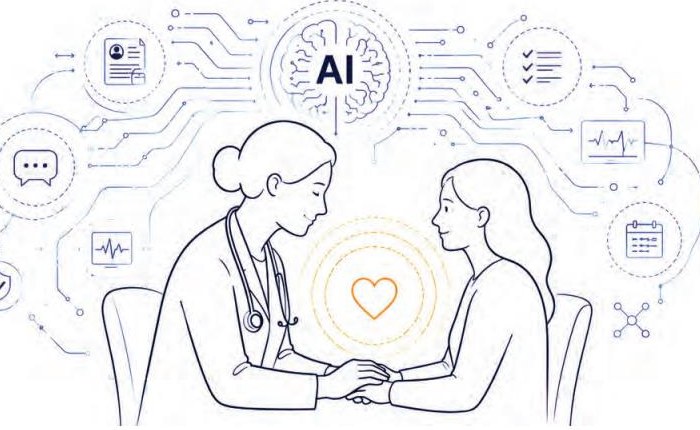
Key takeaways
- Start with an open question: “Tell me what has been happening.”
- The same word, like “dizzy”, can mean very different things, so ask patients to describe it.
- AI can only work with the information it receives, so a careful history comes first.
- The future is doctor plus AI, with the clinician still responsible for the patient.
A patient walks into the consultation room. Before the blood tests are reviewed, before the CT scan is opened, or before artificial intelligence (AI) generates a list of possible diagnoses, the doctor has one essential source of information: the patient’s story.
“Tell me what has been happening.”
It sounds simple. Yet it may be one of medicine’s most useful diagnostic tools.
Healthcare is changing rapidly. AI can analyze vast amounts of information, identify patterns, summarize medical records, and generate differential diagnoses within seconds. Electronic health records and clinical decision-support systems have made information more accessible than ever.
Yet, as technology becomes more sophisticated, preserving the human art of history-taking becomes increasingly important.
The patient is not a dataset
Modern healthcare produces enormous amounts of data, from blood test results and imaging to ECGs, medication lists, and previous medical records. But data alone does not always tell the whole story.
A patient presenting with “breathlessness” may be describing exertional limitation, orthopnea, anxiety, or an entirely different sensation. A patient complaining of “dizziness” may mean vertigo, presyncope, imbalance, or sheer weakness.
The words entered into the medical record may be identical, but their clinical meaning may differ greatly.
That is why the clinician’s first task is not simply to find an answer. It is to understand what the patient means.
Start with the story, not the checklist
Electronic records and structured templates are valuable. They help clinicians to make consistent documentation and reduce omissions. However, consultation should not become an interrogation.
“Any fever? Any cough? Any weight loss?”
A patient may answer “no” to all three and still have an important story to tell.
Now consider a different way:
“Tell me what has been happening.”
The patient may describe a loss of appetite, progressive fatigue, difficulty climbing stairs, or a change in their daily routine. The clinician can then explore the relevant details.
Good history-taking is therefore not simply about asking more questions. It is about asking the right questions.
The question behind the question
Patients do not always use medical terminology to describe their symptoms.
A patient might say, “My heart is stopping.” The clinician’s task is to understand what the patient experienced. Was it a palpitation, a brief pause, chest discomfort, presyncope, or fear?
Similarly, when someone says, “I feel dizzy,” asking, “Can you describe exactly what you feel when you say dizzy?” can completely change the direction of the consultation.
The art of history-taking lies in translating the patient’s experience into clinically meaningful information without losing the patient’s original story.
The right question can prevent the wrong treatment.
Listening is a diagnostic skill
One of the most underrated clinical skills is simply allowing patients to speak.
Patients often provide important diagnostic information spontaneously. Their word choice, the sequence of events, and what they emphasize can all provide clues.
Sometimes the most useful information emerges between the questions.
Listening does not replace clinical reasoning. It is part of clinical reasoning.
AI can help — but only if we give it the right story
AI has enormous potential in clinical practice. It can summarize complex records, suggest possible diagnoses, highlight medication interactions, and raise relevant clinical questions.
But there is an important limitation: AI can only work with the information it receives.
If the history is incomplete, the resulting analysis may also be incomplete. If “chest pain” is recorded without clarifying whether it is exertional, pleuritic, positional, or associated with other symptoms, even the most sophisticated system is working with limited clinical information.
The clinician is therefore the first link in the chain of clinical data quality.
Before AI can help interpret a case, the patient’s experience must first be understood.
The human context matters
Medicine is not simply about identifying diseases. It is about caring for people who live with disease.
Two patients with the same diagnosis may need very different approaches. One may have strong family support; another may live alone. One may be able to afford medication easily; another may struggle with its cost. One may understand their diagnosis clearly; another may have significant fears or misconceptions.
These factors may not appear in a blood test or CT scan. They emerge through conversation.
A proper history therefore asks not only, “What disease does this patient have?” but also “Who is this patient, and how is this illness affecting their life?”
History-taking is a patient-safety tool
Good history-taking can prevent errors and improve patient safety.
Medication reconciliation is a good example. A patient may not remember medication names but may remember “the small white tablet I take in the morning.” Asking them to show their medicines may be more useful than simply asking whether they take them.
Similarly, documenting “penicillin allergy” is not enough. The clinician should establish what happened when the patient took it. Was it a mild rash, intolerance, or an episode of anaphylaxis?
The right question can prevent the wrong treatment.
The future: doctor plus AI
The answer is not to resist technology, but to use it intelligently.
AI can support clinicians by summarizing medical records, identifying patterns, generating differential diagnoses, and informing evidence-based decisions. These capabilities can improve efficiency and help clinicians manage complex information.
At the same time, the human dimensions of medicine must remain central: listening carefully, understanding context, recognizing uncertainty, exploring concerns, building trust, and making shared decisions.
The ideal future is therefore not doctor versus AI, but doctor plus AI.
Technology can support clinical judgment, but the clinician remains responsible for the patient.
Conclusion
We are entering an extraordinary era in medicine. AI will continue to transform how diseases are diagnosed and treated. Yet clinical care will still begin with one human being sitting in front of another.
Before opening the electronic record, asking AI for a differential diagnosis, or ordering the next investigation, perhaps we should remember one of medicine’s simplest and most powerful questions:
“Tell me what has been happening.”
Because in the age of AI, the art of listening may become one of the most important clinical skills we have left.