Key takeaways
- Moving on clinically is not the same as moving on emotionally.
- Mark the end of a shift with a small ritual: change clothes, take a short walk or listen to music.
- Talk through difficult cases with a trusted colleague, and seek professional support if distress persists.
- Rest and boundaries are not indifference; they make our care sustainable.
For a friend who gives so much of himself to his work that he sometimes forgets to keep a little for himself. He carries the hospital home, answers calls day and night even after signing off, and places every responsibility ahead of the simple act of unwinding.
The shift ends, but the day does not end there
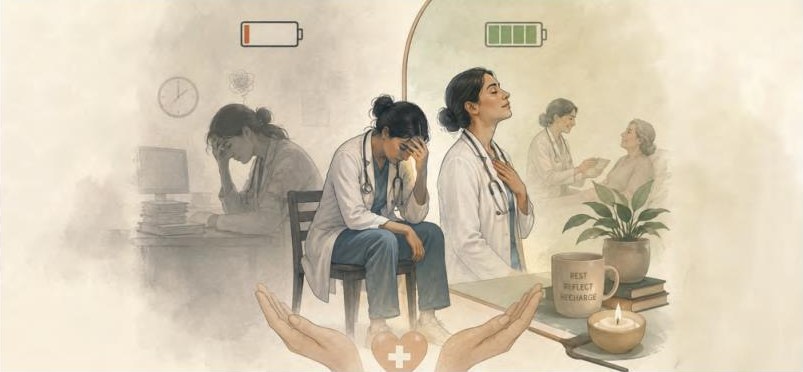
A frightened face in triage. The urgency of a resuscitation. A difficult conversation with a family. The silence that follows an outcome we had hoped to avoid. We hand over, remove our ID cards, change out of our scrubs, and head home, yet part of our minds remains somewhere between the resuscitation bay and the bedside.
Officially, our work is done, but our minds keep working.
We replay decisions, revisit conversations, and wonder whether we could have done something differently. The shift follows us to the dinner table, interrupts our sleep, and quietly takes away our ability to be fully present with the people waiting for us at home.
The weight we carry home
Whether we are doctors, nurses, technicians, therapists, or any of the many colleagues who keep a hospital running, we are trained to remain composed and put patients first, often without a second thought.
In a busy hospital, and especially in emergency care, a routine shift can turn into a life-or-death situation within minutes. We rarely have time to pause and absorb what happened before the next patient arrives. We adapt, we move on, and do what needs to be done. But moving on clinically is not the same as moving on emotionally.
Some cases stay with us, even when we know we acted with the best judgment and resources available. Often, we do not talk about them. We tell ourselves we should be strong enough to handle them, that everyone is tired, and that we will have time later to rest. And so, we continue.
Over time, repeatedly postponing rest affect our sleep, mood, concentration, relationships, and enjoyment of life outside work. An occasional difficult day can gradually become a way of living. We must be careful not to confuse our ability to endure with an obligation to endure endlessly.
The people beyond the hospital doors
Beyond the hospital, another world is waiting. Partners want a conversation. Children want to tell us about their day. Parents want to know how we are doing. Friends call simply because they miss us.
Yet sometimes we arrive home physically present but mentally elsewhere: sitting at the dinner table while replaying a case, half-listening while planning tomorrow, with time for our families but too little energy left to give them.
Our families understand the demands of healthcare. They adjust to unpredictable rosters, missed functions and festivals, cancelled plans, and the tiredness that follows night duty. Their understanding is precious, but it does not make their need for us any less real. They do not expect us to solve every problem or have every answer. Often, they simply want us to be there. A few minutes of undistracted conversation, a meal together, a child’s story properly heard, time beside someone without a phone in hand: these small moments reconnect us with the lives we are working so hard to support.
We are present for strangers during some of their most difficult moments. We owe the same presence to the people who share our ordinary ones.

We must be careful not to confuse our ability to endure with an obligation to endure endlessly.
The guilt of switching off
For many of us, resting is harder than it sounds. There is always another patient, another task, another colleague who may need help, another examination, or another goal. Even on a day off, rest can feel like time wasted, and saying no can feel like letting someone down.
In a profession that values commitment so highly, it is easy to believe that always being available proves dedication. It is not.
We can care deeply about our patients without allowing our whole lives to revolve around work. Sleep, family, recreation, and personal time are legitimate needs, not indulgences. Switching off does not mean we care less. It means allowing ourselves to recover so that we can return with our attention, judgment, and compassion intact.
Learning to leave work at work
There is no perfect formula for achieving this, especially in healthcare. Emergencies do not follow schedules, and difficult experiences do not disappear on command. But a few small habits can make the transition easier.
Mark the end of the shift. Give yourself a few quiet minutes before moving into the next part of the day. Change out of your work clothes, take a short walk, listen to some music, or sit quietly. A small ritual can help signal to the mind that the shift is over.
Converse about difficult experiences. If a case keeps troubling you, discuss it with a trusted colleague or participate in a team debrief. If the distress persists or starts affecting daily life, seek professional support. No one should have to process everything alone.
Protect the basics. Sleep, nutrition, physical activity, and wellness form the foundation of well-being. Shift work makes these harder to maintain, so plan for them deliberately. After a night shift, proper rest may be more important than squeezing every pending errand into the day.
Use your time off with intention. Reconnecting with yourselves does not require a holiday or a perfect wellness routine. A proper meal, an evening with family, a call to an old friend, time outdoors, or a return to a neglected hobby may be enough.
Know when enough is enough. Where clinical and operational responsibilities allow, protect your off-duty hours and avoid routinely giving up rest for extra commitments. Boundaries are not a sign of indifference; they help make our contribution sustainable. None of this will make us immune to stress. The aim is simpler: to remember that our lives deserve attention even when work seems to demand all of it.
Wellness is a shared responsibility
Individual habits cannot fix every workplace problem. We cannot expect people to recover without reasonable opportunities to rest, or to speak openly about their well-being where admitting difficulty is seen as weakness. A healthy workforce cannot be built by celebrating exhaustion while overlooking the conditions that produce it.
At KIMSHEALTH, we recognize staff wellbeing as an important part of creating a healthy, supportive workplace. Through wellness initiatives and a culture of mutual support, we continue to recognize that caring for healthcare professionals is just as important as the care they provide to patients.
Small gestures matter, too: checking on a colleague after a difficult case, supporting one another during demanding shifts, and creating an environment where people feel comfortable acknowledging when an experience has been emotionally challenging. It is okay to acknowledge when something has been emotionally challenging.
Resilience should not mean silently enduring every difficulty; it should also mean knowing when to seek support and having the reassurance that support is available. By continuing to strengthen a culture of care, understanding and shared responsibility, we can help ensure that the people who care for others feel cared for themselves. After all, the well-being of our healthcare teams is essential to deliver safer, kinder, and more sustainable patient care.
More than our designations
Medicine gives us purpose, identity, and the privilege of making a difference. But it can take up so much of who we are that we start measuring our worth by productivity, achievements, and ability to carry on without appearing tired.
We become the doctors, nurses, residents, and staff that everyone depends on. But who are we when the shift ends?
We are people who love music, conversation, family, friendships, travel, quiet mornings, and ordinary moments that have nothing to do with medicine. We have dreams beyond our next milestone, relationships that need our attention, and interests that deserve our time. These are not distractions from our purpose. They are an essential to what makes life meaningful.
We will not always manage a perfect separation between work and life. Some days, a case will follow us home. Some nights sleep will be interrupted by thoughts we cannot quieten. Some shifts will leave us nothing but the need for rest. The goal is not to become unaffected by our work. It is to recognize when we need to pause, seek support, reconnect, and begin again.

When the shift ends
The next time we walk out of the hospital, perhaps we can remind ourselves that we did what we could with the knowledge, resources, and circumstances available to us that day. We can learn from what happened without carrying every moment as a personal burden.
The hospital will need our skills again tomorrow. Our patients will need our compassion, and our colleagues will need our teamwork. But beyond those doors, another part of life is waiting.
Let us return to it not only as professionals who have finished another shift, but also as people who deserve rest, connection, joy, and the freedom to be more than our work.
The shift ends at the hospital doors. Our lives should not have to wait on the other side of them.