Key takeaways
- Clinician exhaustion is largely a workflow design problem, not a lack of resilience.
- Ambient AI documentation can draft notes during the consultation and cut after-hours charting.
- Poorly implemented AI can add work; success needs clinicians involved from the start, and training.
- Every AI output still needs human review, with consent and strong privacy safeguards.
A few years ago, I was observing an outpatient clinic during a routine workflow review. The physician was known to be efficient, thorough, and highly respected by her peers. Yet for most of a 15-minute consultation, her eyes remained fixed on the computer screen rather than on her patient. She typed while listening, clicked through templates while nodding, and hurried to complete every required field before the next patient arrived.
Towards the end of the consultation, the patient — an elderly man newly diagnosed with diabetes — asked a simple question.
“Doctor, do you think I’ll be okay?”
She looked up from the keyboard, paused briefly, and answered honestly. She was a good doctor. But that pause revealed something important. For a few seconds, she had to shift her attention away from the demands of documentation and be fully present with the person sitting in front of her.
That brief interaction explained clinician exhaustion better than any survey ever could.
Patients rarely ask for miracle technology. What they want is a doctor who looks at them, asks how they are really doing, and listens long enough for them to feel heard. That human connection builds trust, eases anxiety, and often marks the beginning of healing. Ironically, it is also the part of medicine that technology has been quietly crowding out.
A design problem, not a willpower problem
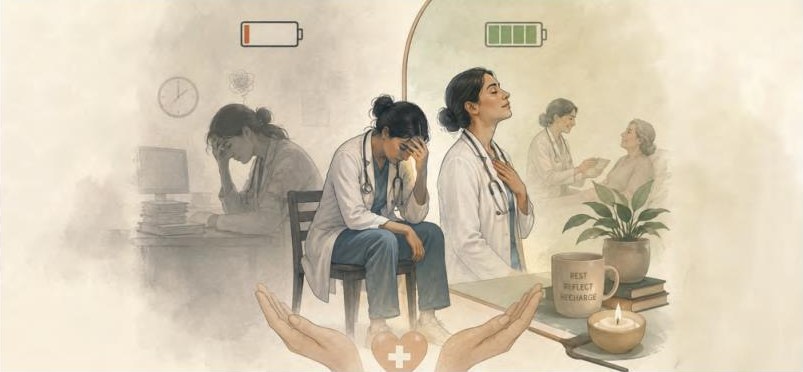
Clinician exhaustion is often portrayed as a problem of resilience or time management. In reality, it is largely a workflow design problem.
Electronic medical records have made healthcare safer and more organized, but they have also introduced endless clicks, mandatory fields, and documentation requirements. Many physicians now spend almost as much time documenting care as they do interacting with patients. Nurses often log into multiple software systems during a single shift. Every minute spent feeding a computer is a minute not spent caring for a patient.
This is the environment into which AI has arrived.
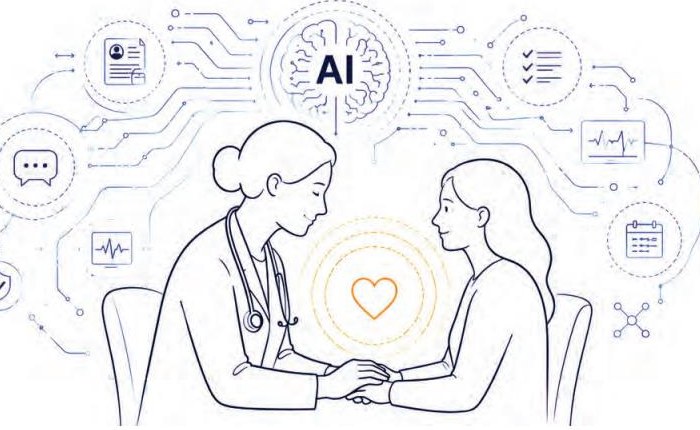
AI in healthcare is not one technology but a collection of tools designed to reduce administrative work. Ambient documentation systems can, with patient consent, listen to consultations and prepare draft clinical notes. Clinical decision-support tools can flag abnormal trends and potential risks. Administrative AI can assist with coding, prior authorizations, and inbox management, while predictive workforce tools help managers anticipate staffing shortages.
None of these systems replaces clinical judgment. Their purpose is much simpler: to remove friction from work that does not require a clinician’s expertise and return that time to patient care.
What works, what doesn’t
Where AI has been introduced thoughtfully, the benefits are tangible. Ambient documentation systems have enabled some physicians to complete notes during the consultation instead of hours later, reducing after-hours charting and allowing them to leave work on time. One clinician remarked that she had started making eye contact with patients again — something she had not realized she had stopped doing until it returned.
Poor implementation, however, tells a different story. In one hospital, an AI-powered inbox assistant was introduced with minimal training. Clinicians found themselves spending more time correcting AI-generated responses than writing messages themselves, and the system was abandoned within months.
The difference was not the technology. It was the implementation. Successful projects involve clinicians from the planning stage, provide adequate training, and treat AI adoption as organizational change rather than simply another software installation.
Why it matters
Clinician exhaustion is not merely a workforce issue — it is a patient safety issue.
Fatigue increases the likelihood of errors, while rushed documentation can lead to omissions or inaccurate records. Reducing administrative burden gives clinicians more time for direct patient care, improves the quality of documentation, and strengthens continuity of care.
As one healthcare leader observed, “Exhaustion is not a wellness issue sitting beside patient safety. It sits directly underneath it.”
The honest limitations
AI is not a cure-all.
Cost remains a major barrier, particularly for smaller hospitals that cannot afford sophisticated systems. Privacy demands careful attention because any technology that listens to clinical conversations handles highly sensitive patient information. Robust consent processes, encryption, secure data storage, and clear governance are essential.
Accuracy also requires human oversight. AI-generated notes can contain transcription errors, omit important details, or misinterpret conversations. Clinicians remain responsible for reviewing every output before it becomes part of the medical record.
Successful implementation therefore depends not only on technology but also on governance, auditing, accountability, and ongoing training.
Exhaustion is not a wellness issue sitting beside patient safety. It sits directly underneath it.
Getting it right
Hospitals that succeed with AI usually begin with one department and one clearly defined problem rather than an organization-wide rollout. Progress should be measured using practical outcomes such as documentation time, after-hours charting, and time available for direct patient care — not satisfaction surveys alone.
Before adopting any new system, one simple question is worth asking:
Will this technology bring clinicians closer to their patients, or pull them further away?
The same principle should guide purchasing decisions. The cheapest system is not necessarily the best investment, nor is the most recognizable brand. The right solution is the one that genuinely reduces administrative burden, integrates smoothly into clinical workflows, and improves patient care.
Coming back to that consultation
The technology that matters most in healthcare is not the one that impresses a boardroom. It is the one that allows a doctor to look up from the screen, meet a patient’s eyes, and answer a difficult question without a keyboard standing between them.
AI will not solve clinician exhaustion on its own. But when implemented thoughtfully and designed around the people who deliver care every day, it can give clinicians back something they have been quietly losing for years: the time and attention to be fully present with the person in front of them.
In the end, the true measure of AI in healthcare will not be how much work it can do, but how much humanity it can help restore.