Key takeaways
- A depleted healer is a clinical risk: self-care is part of clinical competence.
- Decision fatigue builds over a shift and increases reliance on mental shortcuts.
- Try the 3-2-1 reset while hand-washing: three breaths, two muscle releases, one mental reset.
- Sip water through the day, avoid caffeine late in the day and choose protein-rich snacks.
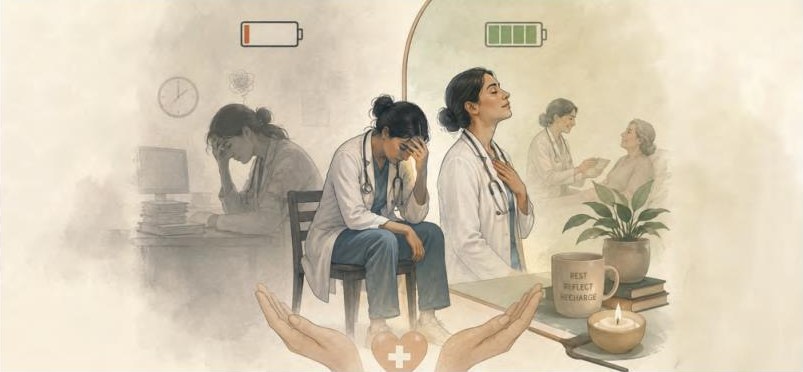
We spend our lives monitoring the vital signs of others, but who monitors the monitor?
In a profession where self-sacrifice is often worn as a badge of honor, many of us have come to believe that our own physical and emotional needs are secondary to the pager. Yet it is time to reframe self-care. It is not a luxury or a Sunday afternoon indulgence; it is a non-negotiable part of clinical competence. A depleted healer is a clinical risk. To provide the best possible care for our patients, we must first take care of ourselves.
The cortisol trap
Whether you work in the emergency department or a busy outpatient clinic, the expectation of being ‘always on’ keeps the body’s stress response activated. This is the cortisol trap.
When the body’s ‘fight-or-flight’ response never fully switches off, cortisol levels can remain elevated for prolonged periods. This does more than make us feel stressed. Chronic stress can affect the way the brain functions, making it harder to think clearly, concentrate, and make the calm, analytical decisions that good clinical care demands.
Over time, repeated exposure to stress takes a cumulative toll on the body.
The decision fatigue curve
Just as a surgeon depends on sharp instruments, a physician depends on a well-rested brain. Yet clinical judgment is not an unlimited resource.
Every prescription, every triage decision, every interpretation of an investigation, and every difficult conversation with a patient’s family draws upon a finite reserve of mental energy. This gradual depletion is known as decision fatigue. By the end of a long shift, the prefrontal cortex — the seat of executive function in the brain — begins to “brown out” and becomes less efficient.
When mental reserves are low, the brain naturally defaults to the path of least resistance and begins to rely more on cognitive shortcuts, which can increase the risk of overlooking details or making errors in judgment.
Recognizing that your brain has a finite “battery life” is the first step towards protecting both yourself and your patients.
The hazards we ignore
We often ignore the ‘occupational hazards’ of medicine until they accumulate and evolve into chronic health problems.
- Musculoskeletal strain: Hours spent charting at computers can lead to ‘tech neck,’ while prolonged standing during ward rounds or lengthy procedures places continuous stress on the back, hips, and legs. Over time, this may contribute to chronic neck and back pain, muscle fatigue, and varicose veins.
- The metabolic impact: Irregular eating patterns, skipped meals, and the ‘grab-and-go’ culture of hospital cafeterias can disrupt normal metabolism. Combined with chronic stress, these habits may contribute to blood sugar fluctuations, insulin resistance, and systemic inflammation over time.
On-shift ‘micro-therapies’
A 30-minute break is not always possible during a busy shift. But most clinicians can spare a few seconds between patients. These brief ‘micro-therapies’ can help interrupt the stress response, improve focus, reset the nervous system, and prepare you for the next patient.
The 3-2-1 breathing anchor
Turn the ritual of hand-washing — a frequent clinical necessity — into a physiological reset:
- Three deep breaths: Take slow, diaphragmatic breaths to activate the body’s relaxation response and reduce stress.
- Two muscle releases: Consciously relax your shoulders and unclench your jaw to release built-up tension.
- One mental reset: Silently remind yourself: “I am fully present for this next patient.”
Micro-stretches and ergonomics
Taking care of your body at work involves more than simply having a good chair. Position your computer monitor at eye level to reduce neck strain, and wear comfortable, supportive footwear if your work requires long hours on your feet.
During charting, practice simple ‘micro-stretches’ such as shoulder rolls, neck stretches, ankle pumps, or seated leg raises to encourage blood flow and prevent venous stasis.
Healing the healer is not an act of selfishness; it is one of the foundations of excellent clinical practice.
The nutritional prescription
What we put into our bodies has a direct impact on our energy, concentration, and ability to make sound decisions throughout the day.
Strategic hydration
Even mild dehydration can affect concentration, memory, mood, and physical performance. In a busy clinical setting, it often presents as fatigue, headaches, brain fog, or irritability. Carry a reusable water bottle and take small, regular sips throughout the day instead of drinking large amounts only during infrequent breaks.
The caffeine cut-off
Caffeine can improve alertness, but its effects last longer than many people realize. It has a half-life of about five to six hours, meaning that a cup of coffee in the afternoon may still be affecting your body well into the evening.
If possible, avoid caffeine in the late afternoon or evening to protect your sleep hygiene and ensure the deep, restorative REM sleep necessary for memory consolidation.
The ‘protein first’ rule
To avoid the mid-afternoon energy slump, choose snacks that are rich in protein rather than relying on sugary or highly refined carbohydrates. While carbohydrate-heavy snacks may provide a quick burst of energy, they are often followed by a drop in blood sugar that leaves you feeling tired and less focused.
Sustained energy: Foods such as Greek yogurt, nuts, or protein shakes provide a steady source of energy and help you stay full for longer.
On-the-go fuel: Keep portable snacks such as nuts, seeds, jerky, or protein bars in your white coat pocket. These help maintain more stable blood glucose levels, providing your brain with a steadier supply of energy and reducing the sharp spikes and crashes that can follow sugary snacks.
The ethical imperative of self-care
The culture of medicine has long encouraged clinicians to put their own needs last, as though self-sacrifice were the hallmark of professional commitment. The most resilient and effective clinicians are those who recognize that caring for themselves is an essential part of caring for their patients.
By managing stress, protecting our decision-making capacity, moving regularly, staying hydrated, eating well, and prioritizing good sleep, we are not simply looking after ourselves — we are preserving the physical and mental resources needed to deliver safe, high-quality care.
Healing the healer is not an act of selfishness; it is one of the foundations of excellent clinical practice.