Key takeaways
- Normal screen use doesn’t permanently damage your eyes; blue-light glasses are largely unnecessary.
- Bright screens in the evening suppress melatonin, so avoid them 60 to 90 minutes before sleep.
- At least 90 minutes outdoors a day, and fewer long close-up sessions, can roughly halve a child’s risk of near-sightedness.
- Use the 20-20-20 rule: every 20 minutes, look 20 feet away for 20 seconds.
The average adult spends about seven hours a day looking at a screen. For Generation Z, the average is closer to nine. It is no surprise, then, that eye doctors everywhere are asked the same question: Are the screens ruining my eyes? The honest answer is reassuring.
Are screens really damaging your eyes?
(Spoiler: Not the way you think)
Modern screens emit a small amount of visible blue light, but at normal viewing distances that light is far too weak to damage the retina at the back of the eye. In fact, spending a minute outdoors on a sunny day exposes your eyes to far more blue light than an entire evening spent using a smartphone. Major reviews published over the last five years — including one in the Journal of Personalized Medicine and a statement from the American Academy of Ophthalmology — have found no evidence that normal screen use causes permanent eye damage.
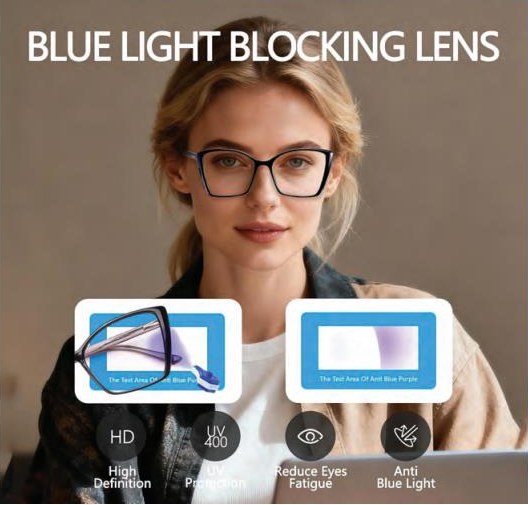
So the “blue-light filtering” glasses sold online, typically BHD 20 to 25 (about Rs 5100 to 6400), are largely a solution in search of a problem. They may slightly reduce eye strain in dimly lit rooms, but no major study has shown that they prevent eye disease.
Why your phone is stealing your sleep
Blue light does not damage the eye, but it tells your brain it is still daytime and can disrupt your body’s internal clock. Deep within the retina sits a small group of light-sensitive cells whose job is to signal the brain’s master clock. These cells are especially sensitive to the blue wavelengths emitted by LED screens.
Exposure to bright blue light in the evening suppresses the production of melatonin, the sleep hormone. Even an hour of screen use before bedtime can make you fall asleep more slowly, sleep less deeply, and wake up less refreshed.
Recent studies suggest that wearing blue-light blocking lenses before bed can produce a modest improvement in how quickly people fall asleep and how long they sleep. The benefit is small, but the biological mechanism is real. After all, blue light is also the color of the sky — it is one of the signals that tells our brain it is daytime. As bedtime approaches, reducing exposure to this wavelength can help the body prepare for sleep.
Practical rule: Avoid bright screens 60 to 90 minutes before sleep. If you need to use one, switch to the warmest color setting (or night mode), reduce the brightness to below 50%, and hold the screen as far from your face as is comfortable.
The three ways screens really affect your eyes
What screens can cause, especially after long uninterrupted sessions:
- Tired, strained eyes: Temporary, never permanent.
- Dry, gritty eyes: Staring reduces blinking by up to 60 percent, with short half-blinks that fail to properly re-spread the tear film.
- Near-sightedness (myopia) in children: The only screen-related problem with potentially lasting consequences.
Children and near-sightedness
Childhood near-sightedness has risen sharply over the last thirty years. A major international review estimates that four in ten children and adolescents worldwide are at risk of becoming nearsighted in the coming decades. In parts of East Asia, the prevalence already exceeds 80%. For instance, urban children in the Gulf spend more time indoors and on digital devices than previous generations.
In a nearsighted eye, the eyeball grows slightly too long, so light rays focus in front of the retina rather than directly on it. The result is a blurred image on the retina. Glasses correct the focus and restore clear vision, but they do not slow the eye from becoming progressively more myopic.
This matters because severe near-sightedness is more than an inconvenience. It increases the lifetime risk of retinal detachment, damage to the central retina (a leading cause of blindness in working-age adults), glaucoma, and early cataract formation. The good news is that prevention works. Two habits can reduce a child’s risk of becoming nearsighted by about half:
- Spend at least 90 minutes outdoors every day.
- Limit prolonged periods of uninterrupted, close-up screen use; for children already near-sighted, four clinically proven options can slow its progression significantly. Ordinary glasses are not one of them.
The proven options include:
- Myopia-control spectacle lenses that look like ordinary glasses but contain specially designed optical elements that blur the side image to slow growth. They are often the first choice.
- Dual-focus contact lenses worn during the day.
- Overnight corneal-reshaping lenses that let the child see clearly during the day without glasses.
- Low-dose atropine eye drops, used nightly, particularly in younger children.
All four have been shown to slow the progression of myopia. If your child has just been diagnosed with near-sightedness, ask your ophthalmologist specifically about these options. Not every clinic offers them, and they are most effective during the growing years.
Five habits that can protect your eyes
The 20-20-20 rule: Every 20 minutes, look at something 20 feet away for 20 seconds. Studies show it reduces symptoms of digital eye strain by giving the tiny focusing muscles inside the eye a chance to relax. Set a quiet reminder to look away at these intervals at first; within a few weeks, it becomes a habit.
Four more habits are worth adopting:
- Blink fully and frequently to keep the tear film evenly spread across the eye.
- Match the room lighting to the brightness of your screen.
- Position the screen at, or just below, eye level.
- Have an eye examination from around age 40 onward — even if your vision seems perfect — to detect silent eye diseases before they affect sight.
The bottom line
Screens are not damaging your eyes in any permanent way. The blue-light glasses marketed to “protect” you are largely a solution in search of a problem.
What screens do cause — strain, dryness, disrupted sleep, and, in children, faster progression of near-sightedness — is real but solvable, with simple habits rather than expensive gadgets.
The fix is not in a pair of BHD 20 blue-light glasses. It is remembering to look up, blink often, spend time outdoors, have regular eye examinations, and put the phone away an hour before bedtime.
Your eyes will do the rest.
Have a question about this?
Send it to a KIMSHEALTH Ophthalmology specialist. We'll reply by email or phone.