Key takeaways
- For toddlers aged 1 to 3, play builds the brain, muscles, social skills and emotional security.
- Meaningful play needs attention and presence, not expensive toys.
- Playing together helps parents notice whether milestones are on track.
- Avoid screen time under age 2, except video calls with family.
To adults, play might look like just fun. To toddlers, play is how they make sense of the world. Peek-a-boo, pat-a-cake, building towers with blocks — these simple moments are more than cute memories. For toddlers, play is essential for brain development, physical growth, and emotional well-being. Between the ages of 1 and 3 years, children move from solitary discovery to social interaction, and play is their primary language for navigating this journey.
What happens when toddlers play?
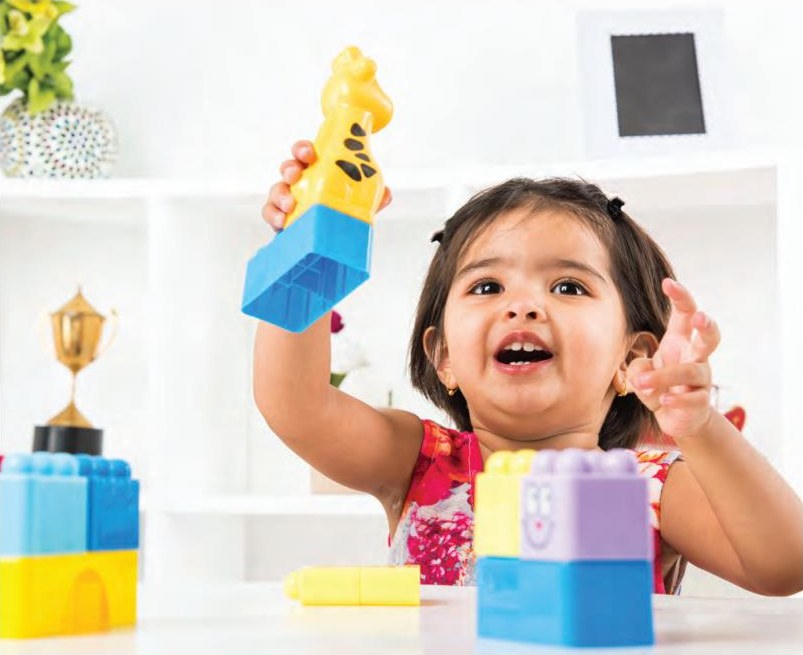
Play is a multisensory, whole-body experience for toddlers. It wires the brain for learning, strengthens muscles, builds social skills, and provides emotional security. When a toddler pours water from one cup to another, they are learning about volume, gravity, and control. When they pretend to feed a doll, they are practising empathy, sequencing, and symbolic thinking.
According to developmental science, play supports toddlers in the following ways:
- Neurological development: Synaptic connections in the brain are reinforced through repeated play-based experiences.
- Sensorimotor integration: Activities such as crawling through tunnels or finger painting help coordinate visual, tactile, and proprioceptive input.
- Socio-emotional growth: Engaging in shared play builds trust, empathy, and self-regulation.
Understanding the mechanisms of play
To understand how children grow and learn, developmental theories such as Jean Piaget’s theory of play are useful. Piaget described three broad types of play behaviour:
- Practice play: Common during the first years of life, this involves repeating the same actions, such as a toddler hiding behind a blanket during peek-a-boo.
- Symbolic play: Recreating everyday experiences and roles, such as pretending to feed a doll or drive a car.
- Games with rules: As children grow older, they begin to engage in simple rule-based games, such as “follow the leader” or basic turn-taking activities.
More than just toys: The role of the adult
Meaningful play does not require expensive gadgets; it requires attention, presence, and space for curiosity. A wooden spoon can become a drum, a spaceship, or a magic wand when a caregiver is nearby, engaged, and responsive.
Simple yet powerful ways to support toddler play include:
- Read together: Lift-the-flap books, repeated rhymes, and pointing to pictures and words all stimulate early literacy.
- Sing and move: Songs such as The Wheels on the Bus enhance rhythm, coordination, and memory.
- Sensory (“messy”) play: Playing with sand, water, or paint provides valuable sensory experiences that support tactile processing.
- Outdoor exploration: Parks and gardens offer opportunities for climbing, running, and simply noticing bugs, leaves, flowers, and clouds.
- Pretend play: Shawls, old handbags, cups, and soft toys become props for storytelling, imagination, and symbolic thinking.
Crucially, caregivers should slow down. On the walk to the park, the “distractions” — a puddle, a flower, or a passing butterfly — are actually the heart of the learning experience.
A wooden spoon can become a drum, a spaceship, or a magic wand when a caregiver is nearby, engaged, and responsive.
Why active parent participation matters
While older siblings can be wonderful playmates, parental involvement is essential for monitoring a child’s development. Playing with your child gives you valuable opportunities to observe whether they are reaching developmental milestones as expected.
If your child has a developmental delay, sensory processing differences, or a neurodivergent profile such as autism, they may benefit from tailored play-based support. Early observation enables parents to seek professional advice sooner. Occupational therapists (OTs) often use play as a primary therapeutic tool to:
- Help children explore sensory experiences in a safe and structured way.
- Use visual schedules for children with language delays.
- Create structured environments that reduce sensory overload.
- Scaffold pretend play skills to strengthen social interaction and reciprocity.
Play is not just for typically developing children; it is a universal developmental tool that can be adapted to support children with diverse learning needs.
The 21st-century question: What about screens?
Current paediatric recommendations suggest that children younger than 2 years should avoid screen time, except for video calls with family members. For children over 2 years, limited, supervised screen use can be beneficial when it encourages interaction. However, screens should never replace active, physical, and imaginative play.
A return to connection
In our fast-paced world, slowing down to play is an act of connection. Traditional games — whether floating toy boats or playing simple thumb fights — carry timeless lessons in balance, imagination, creativity, and joy. By putting down our phones and following a toddler’s lead, we allow their world — and ours — to come alive. In the remarkable journey of discovery, children lead and we follow, helping ensure that the foundations of their future are built on the enduring power of play.
Have a question about this?
Send it to a KIMSHEALTH Paediatrics specialist. We'll reply by email or phone.