Key takeaways
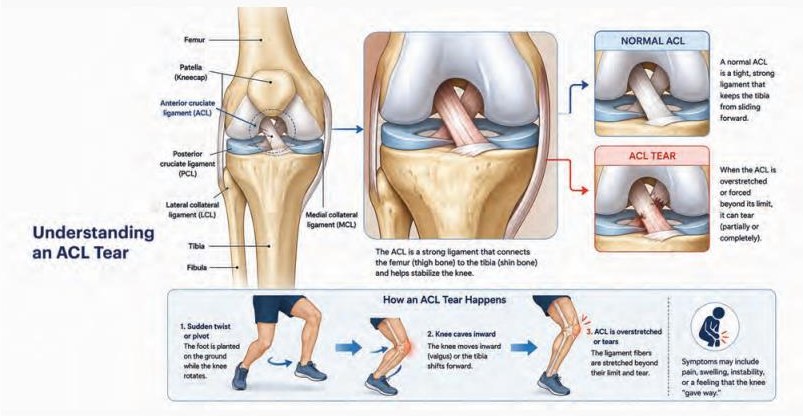
- Most ACL tears happen without contact: a sudden change of direction, an awkward landing or a twist.
- Not every tear needs surgery; it depends on age, activity, symptoms and any other knee damage.
- Reconstruction replaces the ligament with a tendon graft, usually through keyhole (arthroscopic) surgery.
- Rehabilitation decides the outcome; returning to competitive sport usually takes nine to twelve months.
A football match, a weekend badminton game, an evening of basketball with friends, or even a simple misstep while climbing stairs. Sometimes all it takes is one awkward twist of the knee.
Many people describe hearing a distinct “pop,” followed by severe pain and rapid swelling. Others may be able to walk after the injury, only to notice later that the knee repeatedly “gives way.” These are classic signs of an injury to the Anterior Cruciate Ligament, better known as the ACL.
An ACL tear can be frightening, especially for someone who enjoys an active lifestyle. The good news is that advances in treatment and rehabilitation mean that most people can recover well and return to the activities they love.
Understanding the ACL
The ACL is one of the four major ligaments that stabilize the knee. It acts like a strong rope connecting the thigh bone to the shin bone, preventing excessive movement and keeping the knee steady during activities such as running, jumping, pivoting, and changing direction.
When this ligament tears, the knee loses its stability. Some people experience persistent pain, while others find that the knee feels unstable, especially during sudden turns or uneven movements.
How does an ACL tear happen?
Contrary to popular belief, not all ACL injuries result from a direct blow to the knee. In fact, most occur without any contact at all.
A sudden change in direction while running, landing awkwardly after a jump, twisting with the foot firmly planted, or injuries sustained in road traffic accidents are among the common causes. Athletes are at greater risk, but ACL injuries are increasingly seen in people who play sports only occasionally and even in those performing routine daily activities.
Does every ACL tear need surgery?
Not necessarily.
Treatment depends on several factors, including the person’s age, occupation, activity level, symptoms, and whether there are associated injuries such as damage to the meniscus or cartilage.
Some individuals, particularly those with less physically demanding lifestyles, can achieve good results with structured physiotherapy and strengthening exercises alone.
However, surgery is often recommended for young and active individuals, those whose knees repeatedly give way, and those wishing to return to sports that involve cutting, pivoting or jumping.
The decision is always individualized and should be made after a detailed discussion with an orthopedic surgeon.
What is ACL reconstruction?
One of the most common questions patients ask is, “Can’t you simply stitch the torn ligament back together?”
Unfortunately, in most cases, the answer is no.
Unlike many other tissues in the body, the torn ACL has a limited ability to heal on its own. Instead, surgeons reconstruct the ligament by replacing it with a tendon graft. This graft is usually taken from the patient’s own hamstring, patellar tendon, or quadriceps tendon. In selected situations, donor tissue may also be considered.
Today, ACL reconstruction is performed using arthroscopy — a minimally invasive technique in which a tiny camera and specialized instruments are introduced through small incisions around the knee. This approach allows excellent visualization of the joint, less postoperative pain, smaller scars, and a faster recovery compared to traditional open surgery.
Most patients can go home within a day or two after the procedure.
Surgery is only half the story
Perhaps the biggest misconception surrounding ACL reconstruction is that the operation alone restores the knee.
In reality, surgery creates the foundation, but rehabilitation builds the house.
Physiotherapy is the single most important factor determining the outcome. It helps restore knee movement, rebuild muscle strength, improve balance, and retrain the body to move safely and confidently.
Recovery cannot be rushed. Returning to sports before the knee has regained adequate strength and stability significantly increases the risk of another injury.
Surgery creates the foundation, but rehabilitation builds the house.
The road to recovery
Every patient’s recovery is different, but the overall journey follows a gradual progression.
During the first few weeks, the focus is on controlling pain and swelling, restoring knee movement, and walking comfortably.
Over the following months, strengthening exercises become increasingly intensive, with emphasis on the quadriceps, hamstrings, and core muscles. Balance training and sport-specific exercises are introduced step by step.
Many people can return to office work within a few weeks, depending on their job. Light jogging is often possible after several months, while returning to competitive sports usually takes around nine to twelve months. Importantly, the decision to resume sports should be based on functional recovery and strength testing — not simply the passage of time.
Looking beyond surgery
Modern ACL reconstruction has excellent success rates, but long-term success depends on the partnership between the surgeon, physiotherapist, and patient.
Completing rehabilitation, maintaining good muscle strength, learning proper movement techniques, and avoiding premature return to high-risk activities all help reduce the chance of re-injury.
The goal is not merely to heal the ligament but to restore confidence in the knee.
A final word
An ACL injury may feel like a major setback, particularly for young adults and sports enthusiasts. However, it is no longer the career-ending or life-altering injury it was once considered.
Advances in arthroscopic surgery, improved rehabilitation protocols, and a better understanding of sports medicine now allow most patients to return to an active, healthy, and fulfilling life.
If you experience persistent knee instability after an injury, do not ignore it or assume it will improve on its own. Early evaluation and appropriate treatment can prevent further damage to the meniscus and cartilage, protecting the knee for years to come.
Recovery from an ACL injury is not a sprint — it is a carefully planned journey. With patience, commitment, and the right medical guidance, that journey can lead you back to the activities you enjoy, stronger and more confident than before.
Have a question about this?
Send it to a KIMSHEALTH Orthopaedics specialist. We'll reply by email or phone.